
Birch Boards for European Furniture: Grades and Machining
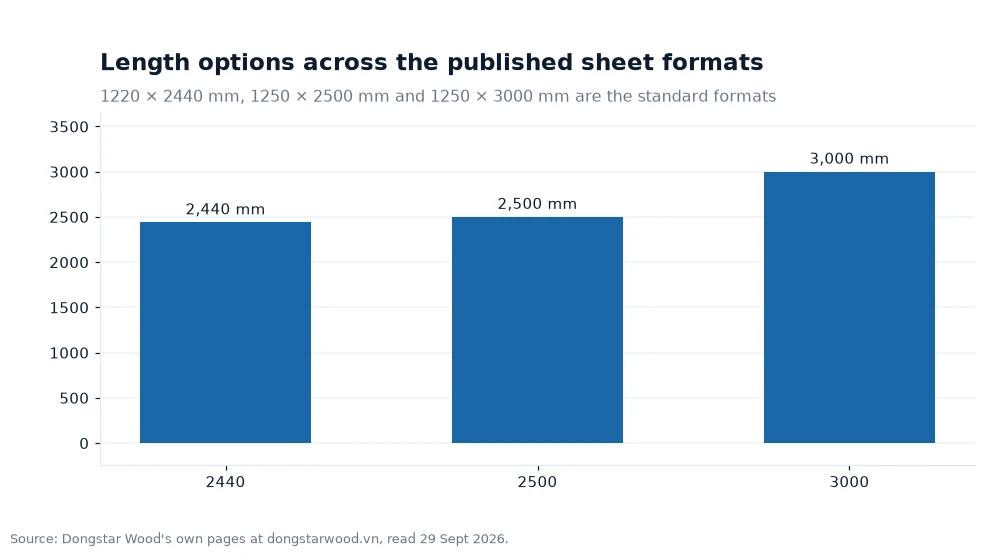
A birch board is a promise about the face and the cut. Dongstar Wood quotes its Birch Plywood across 1220 × 2440 mm, 1250 × 2500 mm and 1250 × 3000 mm formats, in thicknesses from 2.7 mm to 30 mm, with E1, CARB P2 and CE documentation among the compliance options and a light cream to pale brown birch veneer on the face.
Key takeaways
- Four face grades: A-grade outstanding, B-grade more character, C-grade smooth and sound, plus a repaired-defect grade.
- The machining promise: cutting, CNC processing, sanding and edge processing with minimal tear-out.
- The size window: 1220 × 2440, 1250 × 2500 and 1250 × 3000 mm, with 2.7 mm to 30 mm thickness.
- Compliance options: E1, CARB P2 and CE documentation, with low-emission glue systems.
Reading the four face grades
The grade ladder on the birch page runs from A-grade — outstanding condition, some knots and burls allowed — through B-grade with more and larger burls and knots and some colour variation, to C-grade, which is smooth and sound with even more variation, and finally a repaired-defect grade that is free of open defects but may carry some repaired ones.
For a furniture buyer the ladder is a cutting-list calculation. A-grade faces go where the end user sees them; C-grade and the repaired grade go where a lacquer, a laminate or a paint finish will do the talking. The mill publishes the grades so the buyer can allocate them, and the allocation is where the money in a furniture programme is actually saved. The repaired-defect grade deserves a second look, because it is the grade that separates a careful mill from a careless one: a board that is free of open defects but carries repaired ones has been inspected, found wanting and made sound — a process that only exists where quality control is real rather than rhetorical.
Machining behaviour: the promise behind the veneer
A panel that machines badly costs more than a panel that machines well, whatever the invoice says. The birch page promises a multi-layer hardwood core that resists warping while machining, and engineering for cutting, CNC processing, sanding and edge processing with minimal tear-out. Those are the four operations a furniture factory actually performs, and they are named in the order a shop floor performs them.
Minimal tear-out matters most at the edge, because the edge is where a board announces its quality. A birch veneer that cuts cleanly lets the factory run faster feeds and skip rework, and moisture control with panel tolerance for European climates means the board arrives at the machine the same size it was when it left the press. The multi-layer hardwood core is the hidden half of the machining promise: layers that are pressed to a consistent thickness cut the same way at every station, and a board that resists warping during machining stays on the cutting list instead of becoming a template for rework.
The size and thickness window
The published formats cover 1220 × 2440 mm, 1250 × 3000 mm and 1250 × 2500 mm, with custom sizes available, and the thickness span runs from 2.7 mm to 30 mm. That is a wide window, and it is wide on purpose: the same product line covers backing panels, cabinet carcasses and structural furniture parts without the buyer changing suppliers. Custom sizes are available for programmes that need them.
For a European programme the 1250 × 2500 mm format is the natural planning unit, because it divides cleanly into the metric cutting lists European factories work from. A sheet of 1250 × 2500 mm yields 1.25 m × 2.5 m, giving 3.125 m², and a cutting optimiser can price a whole programme from that single number.
Compliance options for the European market
The compliance list on the birch page runs E1, CARB P2 and CE documentation, with low-emission glue systems behind them. For a buyer selling furniture into the European market, those three acronyms cover the questions a retailer will eventually ask: emissions, chemical content and construction-product conformity. The three options are published together so a buyer can match the document to the market.
The documents are worth requesting with the first sample, not the first container. A board that arrives with its E1 and CARB P2 paperwork already filed is a board that can go straight into production; the same board without the paperwork sits in a warehouse while someone chases a certificate.
Surface, finishing and the light cream face
The face veneer is described as light cream to pale brown birch, uniform, and suited to staining, laminating or painting. That sentence is a finishing specification: the board accepts all three routes, which means the buyer chooses the finish on aesthetic and cost grounds rather than being forced into one by the material.
Uniformity is the word that matters for volume. A face that varies wildly between sheets forces the factory to sort panels by colour before finishing; a uniform birch veneer lets the line run the same settings all day. It is a small phrase on the product page and a large saving on the shop floor. The light cream to pale brown tone is also a design input: a face that sits in that range takes a clear finish without the yellow cast a darker veneer would impose, and it laminates without showing the glue line — the practical reasons a finishing department prefers a predictable face.
| Grade | Client's description | Typical furniture allocation |
|---|---|---|
| A-grade | Outstanding condition, some knots and burls allowed | Visible faces, clear finishes |
| B-grade | More and larger burls and knots, colour variation | Painted or laminated visible parts |
| C-grade | Smooth and sound, more variation | Carcasses, hidden structural parts |
| Repaired-defect grade | Free of open defects, may have repaired defects | Cut-to-size components |
Worked example: planning a batch from the format
Plan the programme from the format. A 1250 × 2500 mm sheet yields 1.25 m × 2.5 m, giving 3.125 m², and a furniture batch of 600 units drawing one sheet per unit needs 600 × 3.125 = 1,875 m² of panel. At the published span of 2.7 mm to 30 mm, the same programme can run thin backing boards and thick structural panels from one product line — the arithmetic that turns a size window into a sourcing strategy.
Frequently asked questions
What is the difference between A, B and C grade birch?
A-grade shows excellent condition with some knots and burls permitted, B-grade shows more and larger burls and knots alongside colour variation, and C-grade is smooth and sound with even more variation. A repaired-defect grade is free of open defects and may carry some repaired ones. Allocate grades by visibility, not by price alone.
Which compliance documents come with birch boards?
The published options are E1, CARB P2 and CE documentation, with low-emission glue systems. Request them with the first sample so the board can go straight into production when the container arrives.
What sizes and thicknesses are available?
The standard formats are 1220 × 2440 mm, 1250 × 3000 mm and 1250 × 2500 mm, with custom sizes available, and thickness runs from 2.7 mm to 30 mm. The 1250 × 2500 mm format divides cleanly into metric cutting lists.
Allocating grades across the cutting list
The grade you buy should match the part you cut. Read the company's own profile to review the operation behind the range, then look at the okoume line to compare how a different face species behaves under the same finishing routes. Choose a Birch Plywood Supplier whose published grades, sizes and compliance options match the cutting list you have just written. Buyers who allocate grades before the cutting list is written tend to buy less panel and waste less of what they buy.
The figures shown were compiled from Dongstar Wood's own site accessed 29 Sept 2026[1].