
One Tenth of a Coin: Sizing a Second Container Against a Target
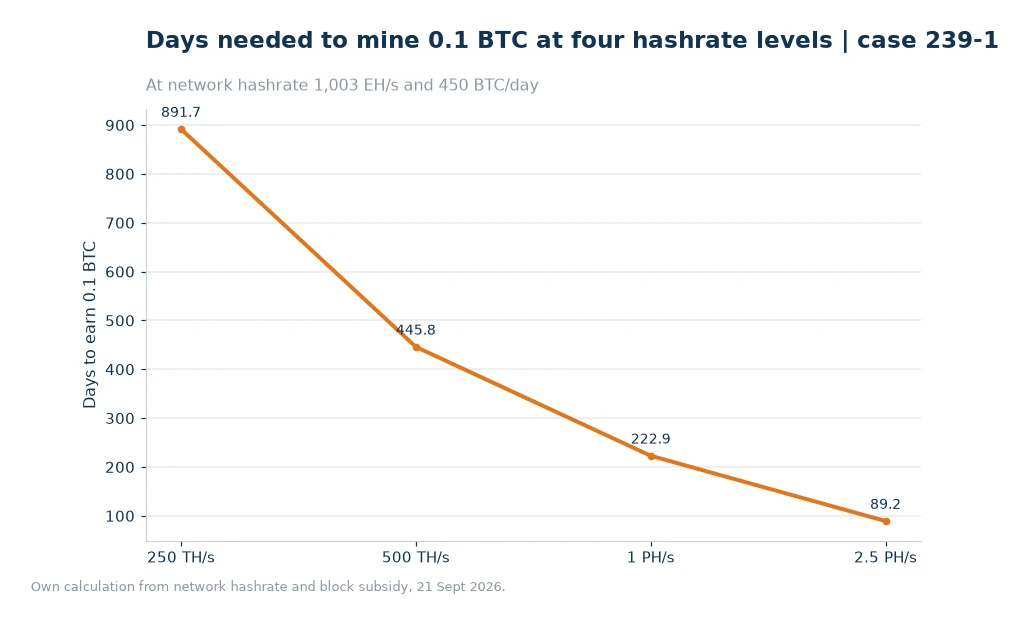
A tenth of a bitcoin is the kind of target that arrives with a business question attached. At 250 TH/s it takes 891.7 days, while at 2.5 PH/s it takes 89.2. Between those two numbers sits the decision to add capacity, rent it, or wait, and the target alone will not make that decision for you.

Key takeaways
- 0.1 BTC takes 891.7 days at 250 TH/s, 445.8 at 500 TH/s, 222.9 at 1 PH/s and 89.2 at 2.5 PH/s.
- The target sets a delivery date, not a rate of return; the return still depends on power, price and hardware cost.
- Pool Hashrate tells you whether the capacity you are buying is competing against a larger network than the one in the seller's example.
- Pool Luck belongs in the variance line of a budget, not in the expected-case line.
Why a tenth is a business number
Small targets are personal; a tenth of a coin is large enough to appear in a treasury conversation. It is the size of balance that someone might hold rather than spend, which means the question shifts from how fast it arrives to whether the capacity that produces it is worth owning at all.
That shift matters because a container is not a miner. It is a building with a feed, a cooling system, a maintenance contract and a depreciation schedule. The coin target can justify the purchase in a spreadsheet, but it cannot tell you whether the building is a good asset. Those are two separate tests, and mixing them is how operators end up with capacity they cannot afford to run.
A deadline, not a return
The 891.7-day figure at 250 TH/s is a delivery date for 0.1 BTC under current conditions. It says nothing about whether the coins cost more to produce than they are worth. To get that, divide the total spend over 891.7 days by 0.1 and compare the result with the market price. If the cost per coin is above the price, the target arrives on schedule and still loses money.
This sounds obvious and is routinely skipped. Sellers quote a payback period that assumes a constant price and no repairs; buyers compare that period with a loan term and call it a plan. The missing line is the one that converts coins into currency at the end, and it is the line that decides whether the second container was a good idea.
Pool Hashrate and the capacity you are comparing
The ViaBTC Pool Hashrate reading, beside the network total, is the context for any capacity quote. A seller who demonstrates 0.1 BTC in 89.2 days is describing 2.5 PH/s against a 1,003 EH/s network. If the network is 1,100 EH/s by the time your container is wired, the same hardware needs about 98 days.
That gap is why contracts are signed against dates and not against coin totals. A container ordered in November may not be hashing until February, and the network does not wait for the electrician. Ask for the hashrate, the energisation date and the tariff in writing, then do the division yourself with the network total you can see on the day you sign.
Pool Luck as a variance line
Budgeting for a container means budgeting for a range. Pool Luck is one source of range: the pool will find more blocks than expected in some months and fewer in others, and a PPLNS record will show it. Even on PPS+, where the hourly credit is stable, the pool's block-finding record affects how the operation looks to a lender or a partner reading the dashboard.
The sensible treatment is a variance line, not a forecast. Decide in advance how large a shortfall the operation can absorb without missing a payment, and size the reserve accordingly. A 0.1 BTC target with a 10% buffer is a different plan from one without, and the difference is a number you can choose rather than a hope you can hold.
Keep the reserve in the same currency as the obligation. A reserve held in coins moves with the price of the target itself, which can double the effect of a short month or cancel it entirely. That is a treasury choice, not a mining one, but it belongs in the same conversation as the container.
Four sizes, four delivery dates
The table prices the same target across four capacity levels and shows what each would produce in a month. The delivery column assumes an order placed on 1 November 2026 and continuous operation from that date.
| Capacity | Hashrate | Days to 0.1 BTC | Delivery date | BTC per 30 days |
|---|---|---|---|---|
| Single rack | 250 TH/s | 891.7 | 11 Apr 2029 | 0.003365 |
| Two racks | 500 TH/s | 445.8 | 21 Jan 2028 | 0.006729 |
| Half container | 1 PH/s | 222.9 | 12 Jun 2027 | 0.013458 |
| Container | 2.5 PH/s | 89.2 | 29 Jan 2027 | 0.033646 |
The dates make the trade-off concrete. Moving from a single rack to a container pulls the target forward by more than two years, and it also multiplies the power draw by ten, the cooling load by ten and the capital at risk by more than ten. The target does not care which of those you can finance.
What the target cannot tell you
It cannot tell you the price of bitcoin on the delivery date, the difficulty then, or the resale value of the equipment. It cannot tell you whether the landlord will renew, whether the grid connection will be upgraded, or whether the tariff will survive the next regulatory review. Those are the risks that turn a schedule into an investment, and they belong in a separate document.
What it can do is anchor the conversation. A board comparing two capacity options can agree that both are measured against 0.1 BTC, that both use the same network total, and that both carry the same fee assumptions. Once those three are fixed, the remaining disagreement is about cost and risk, which is a much more productive argument than a disagreement about arithmetic.
Worked example
Reproduce the single-rack figure, then scale it to the container.
- Per terahash, the network pays 450 ÷ 1,003,100,000 = 0.00000044861 BTC.
- At 250 TH/s: 250 × 0.00000044861 = 0.00011215 BTC a day.
- Days to 0.1 BTC: 0.1 ÷ 0.00011215 = 891.7.
- At 2.5 PH/s, or 2,500 TH/s: 2,500 × 0.00000044861 = 0.00112152 BTC a day.
- Days to 0.1 BTC at that size: 0.1 ÷ 0.00112152 = 89.2.
- Monthly output at 250 TH/s: 0.00011215 × 30 = 0.003365 BTC.
Frequently asked questions
How long does 0.1 BTC take at 250 TH/s?
891.7 days at 1,003 EH/s, because the daily credit is 0.00011215 BTC and 0.1 ÷ 0.00011215 = 891.7.
Does a container pay for itself faster than a rack?
It reaches the coin target faster, but payback depends on the capital cost, the tariff and the resale value. A container can hit 0.1 BTC in 89.2 days and still be a worse purchase than a rack if it costs far more per terahash.
Why does Pool Luck matter in a budget?
It is a source of month-to-month range in what the pool finds. Budget a reserve for a shortfall rather than assuming the average arrives on time, especially if the operation has payments tied to a schedule.
Separate the schedule from the investment case
Write two pages. The first holds the schedule: hashrate, network total, days to 0.1 BTC, delivery date. The second holds the investment case: capital cost, power per month, maintenance, resale value, and the cost per coin at the end. If both pages stand on their own, the capacity decision is defensible.
The Collateral-Pledged Loans page is relevant if the container is financed against coins rather than cash, and the Statistics view supplies the network total for the schedule page. Neither turns a schedule into a guarantee.
Sources: ViaBTC pool state, statistics and loan pages; chain inputs read 21 Sept 2026: network hashrate 1,003 EH/s, difficulty 132.76 T, subsidy 3.125 BTC per block, BTC $84,692. Delivery dates assume a 1 Nov 2026 start and continuous operation at current difficulty. Figures read 21 Sept 2026, published 24 Oct 2026[1].